
recent posts

Tags cloud
For the EIC, More Features Do Not Make a Stronger Value Proposition
For the EIC, More Features Do Not Make a Stronger Value Proposition
Across EIC Accelerator proposal work, one pattern appears again and again: technically impressive companies can still present a surprisingly weak value proposition.
The reason is simple.
They explain the technology before they explain why the technology matters.
A proposal may describe advanced algorithms, proprietary architecture, automation, higher accuracy, faster processing, lower energy consumption or dozens of sophisticated functionalities.
All of that may be technically relevant.
But none of it answers the first commercial question an evaluator needs to understand:
What important problem changes because this technology exists?
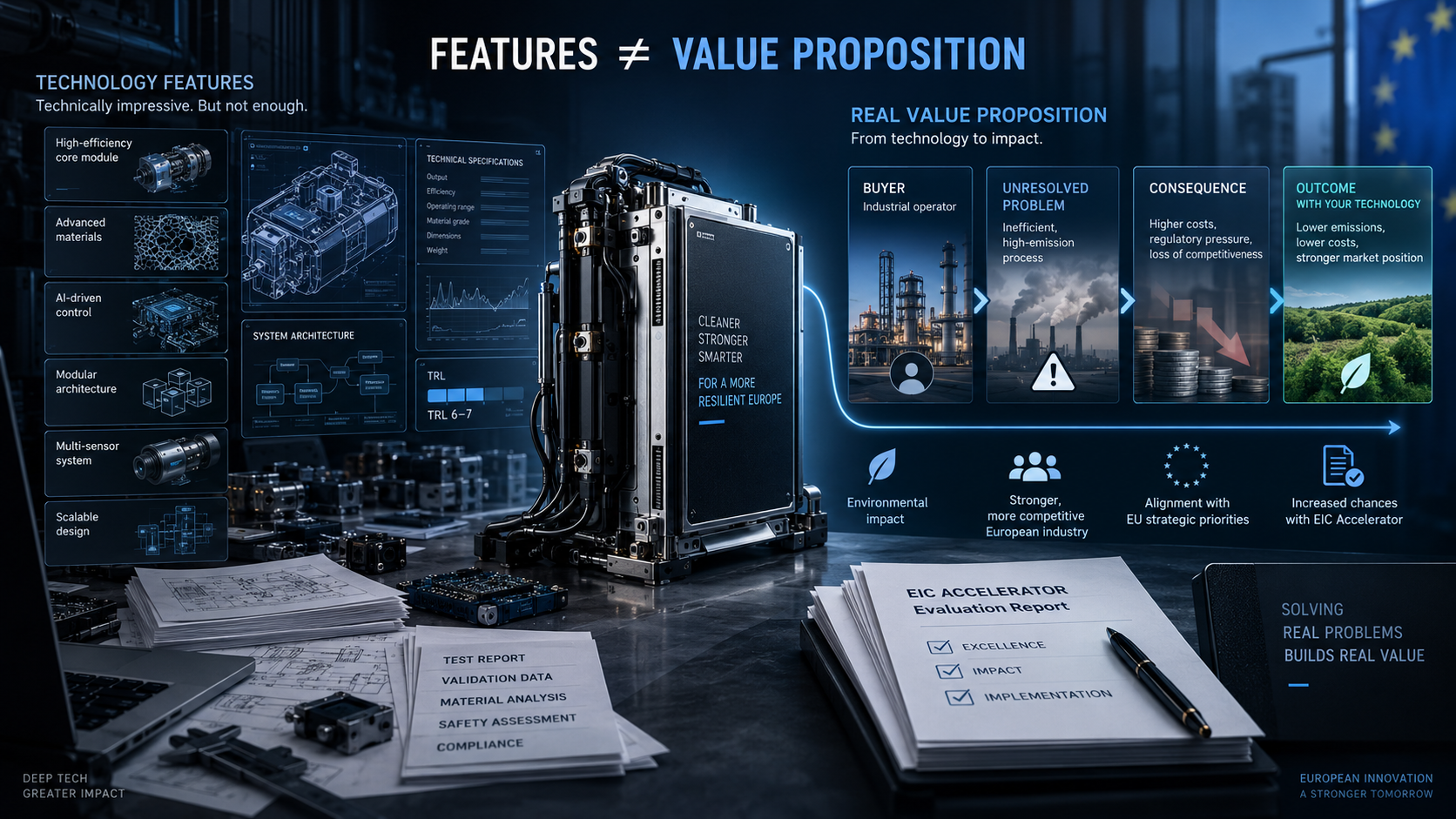
A strong EIC value proposition is not a feature list.
It connects four elements clearly:
→ Who actually needs and pays for the solution?
→ What critical need remains unresolved today?
→ What happens because that need remains unresolved?
→ What materially different outcome becomes possible with the innovation?
That third point is often underestimated.
The problem needs consequences.
1. For the market, that may mean cost, delay, risk, lost productivity, failed procedures, poor scalability or another operational burden.
2. For Europe, it may affect industrial capacity, technological leadership, resilience or dependency on external technologies.
3. For society or the planet, the consequences may appear in health, safety, resource use, emissions or another measurable impact.
Only then does the technology enter the argument.
The technical novelty must explain why the existing limitation can now be overcome.
That is where advanced science, engineering complexity, proprietary know-how and IP become relevant. They support the breakthrough claim; they do not replace the value proposition.
This also changes how competition should be analysed.
A market can contain many existing solutions and still contain an unresolved need. The important question is not whether alternatives exist.
The important question is whether they solve the same critical need, for the same customer, under the same constraint.
If a commercially available solution already does that, the breakthrough argument becomes much harder to defend.
So during EIC application preparation, before adding another page of features, try a much harder test:
Can someone unfamiliar with your technology explain in one sentence:
who needs it, what remains unsolved today, why that matters, and what changes because your innovation exists?
If not, the problem may not be that your technology needs more explanation.
Your value proposition may need rebuilding.
If you are preparing an EIC application and want to understand whether your value proposition is carrying enough of the case, message us here or contact Jesús Lozano at jlozano@siliconcp.com.
#EICAccelerator #EICFunding #ValueProposition #DeepTech #BreakthroughInnovation #ApplicationPreparation